Greater New Orleans Foundation Invests $1 Million in Crescent City Futures Fund

CCCLT is proud to share the news that the Greater New Orleans Foundation has invested $1 million to support the development of the Crescent City Futures Fund! The Futures Fund will support development projects in New Orleans that incorporate the community land trust approach by including long-term or permanently affordable housing units and commercial community benefits. Projects funded through the Futures Fund will help ensure that our local economy and our neighborhoods remain strong and offer opportunity for residents of all income levels. CCCLT is partnering with Capital Impact Partners, a national Community Development Financial Institution, as the administrators of the Futures Fund. Read on for the full press release from the Greater New Orleans Foundation. Continue reading

The Pythian Development Will Offer Affordable Housing, Community-Oriented Commercial Spaces

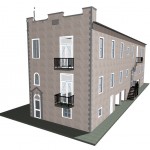
The Pythian project is getting off the ground! Our development in partnership with Green Coast Enterprises will offer six floors of residential units, one floor of community-oriented office spaces, a health clinic, and several well-designed retail spaces on the first two floors.

Crescent City Community Land Trust is helping to secure affordable office space within The Pythian for community-oriented tenants, non-profits, and health-oriented uses. We are also securing 40% of the residential rental units in the building as permanently affordable units, so that more people who work downtown and in our new hospitals will be able to live downtown as well. More information on the development can be found here.

The Pythian building at 234 Loyola was originally built by Samuel L. Green for the Colored Knights of Pythias, a Late 19th/Early 20th Century fraternal order that grew out of a Civil War era organization. Mr. Green was reputed to be the wealthiest African-American in New Orleans, and perhaps in the country. We have renamed the building The Pythian to honor this heritage.

Visit The Pythian’s website for more information on commercial leasing. Information about residential leasing coming in 2015!

Green Coast Enterprises & Crescent City Community Land Trust Launch Redevelopment of Historic 234 Loyola Avenue

Green Coast Enterprises (GCE) and the Crescent City Community Land Trust (CCCLT) today announced the official launch for the redevelopment of the historic Pythian Temple building at 234 Loyola Avenue (Loyola at Gravier Street in the New Orleans Central Business District). The first phase of construction is to remove the modern cladding and stabilize the exterior bricks in preparation for putting the building on the National Register of Historic Places.

“Healthy communities are affordable for working families and local businesses,” said Van Temple, Executive Director of CCCLT. “Our partnership with Green Coast Enterprises will restore one of New Orleans’ most storied buildings and provide prime downtown retail and office space for non-profit and for-profit businesses and homes for families in a range of incomes, as we pursue an equitable and sustainable approach to our city’s renewal.”
Continue reading

Greater New Orleans Foundation Features Crescent City in 2012 Annual Report


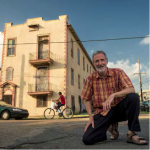
Photo courtesy GNOF; photographer: Jackson Hill

The Greater New Orleans Foundation (GNOF) has just released its annual report that is themed “Where Big Ideas Take Shape.” Crescent City Community Land Trust is featured on Page 4 with a quick overview of our work and approach. Click to download the full annual report from GNOF. The document is an inspirational compendium of GNOF’s difference-making work throughout New Orleans. It also details the organization’s plan for building and launching its Center for Philanthropy, a 20,000 square foot facility that will serve as a nexus of philanthropy and non-profit work throughout greater New Orleans.

Long-Term Starts Now: Crescent City Officially Launches First Project

In collaboration with the Jane Place Neighborhood Sustainability Initiative (JPNSI), Crescent City has officially launched its first project — the historic redevelopment of 2739 Palmyra Street. Crescent City and JPNSI are working in partnership with the Tulane City Center and Alembic Community Development. Click here for the full press release.

Image Courtesy Alembic Community Development

This work highlights Crescent City’s role as a bridge for the long-term, sustainable renewal of New Orleans. With 2739 Palmyra, Crescent City is providing financial support through a predevelopment grant fortified by City of New Orleans HOME dollars and state and federal historic tax credits. Upon completion, JPNSI will continue to own the building, ensuring quality property and financial management. Within its role, Crescent City will deliver technical and stewardship support, both of which will help future residents of 2739 Palmyra and JPNSI to be successful in the long-term. Wholly unique, Crescent City is one of the first organizations of its kind nationwide and is the only organization doing so across the categories of affordable housing, enterprise development and vacant land use.


Got Questions? Shelterforce Has Shared-Equity Homeownership Answers

Shelterforce, the official publication of the National Housing Institute and the nation’s oldest continuously-published housing and community development magazine, has recently developed a series of infographics that answer frequently asked questions about affordable housing and the shared-equity homeownership approach as follows:

  • Didn’t the housing crisis prove low-income people can’t be successful homeowners?
  • Does shared equity build assets?
  • Does affordable housing development lower nearby property values?
  • What’s the point of shared-equity homeownership in weak market areas?

Before we provide the download link, you may be asking already, “What is shared equity?” It means co-ownership between a land trust and a home buyer, which ensures that the buyer can at once get an opportunity to purchase a home and share in the wealth-building power of the homeownership lifecycle.

Alright, download the Shelterforce Answers or visit the National Housing Institute’s answers page at http://www.nhi.org/go/theanswer. Want to keep up with the latest trends and news tied to affordable housing and community building? Make sure to visit and subscribe to Shelterforce.


Crescent City Perspective: Making the Low Income Housing Tax Credit a Permanent Investment

by Van Temple, Executive Director

In the United States, the Low Income Housing Tax Credit program (the source of federal investment for affordable housing) has poured significant dollars into financing more than 2.2 million housing units – this includes one-sixth of all rental housing in the U.S. Fifteen years after construction, many of these homes become unaffordable. That means in less than one generation, the intended purpose of the program and the equal opportunity for high-quality housing among low- and moderate-income populations that comes with it are lost. The cycle begins all over again.

What if the impact of that same investment could last forever? What if by design, the units were constructed to be attractive? What if rental units were created for conversion to home ownership? What if units were clean and safe upon the expiration of the tax credits and available to those who need it most? A recent study by the University of New Orleans in partnership with Crescent City Community Land Trust answers those “what ifs” with clarity: it would renew communities in New Orleans, throughout the state and in cities nationwide for the Long Term.

What can we do in Louisiana today to seize the opportunity for lasting impact via the LIHTC program? This report illustrates how organizations like Crescent City Community Land Trust already provide permanently affordable housing and long-term supportive relationships to help families transition successfully from renting to owning while illuminating the impact:

  • 97% of homeowners in community land trust-based units are still owners after 5 years – compared to only 50% for all other first-time buyers.
  • 67% percent of CLT homeowners who sell their homes purchase market-rate, unsubsidized homes.
  • The foreclosure rate for CLT homeowners across the country is one-tenth the national rate.

By combining the LIHTC program with Crescent City’s model (and that of community land trusts statewide), Louisiana could lead the way, investing what is literally a national “treasure” into millions more families, giving generation after generation their shot at the American Dream.

Importantly, practical next steps are immediately accessible. For example, Louisiana could provide high quality affordable rental housing through blending LIHTC monies with community land trusts oversight and then turn those units into thousands of affordable homes-for-sale.

Interested in learning more? Please read “Supporting Permanently Affordable Housing in the LIHTC Program: An Analysis of State Qualified Allocation Plans,” by the University of New Orleans in partnership with Crescent City Community Land Trust. Want to talk about Renewal for the Long Term? Contact us today!

New Orleans OCD Consolidated Plan Highlights Community Land Trusts

Crescent City Community Land Trust today commented on the City of New Orleans Office of Community Development’s (OCD) recently released 2012-2016 Consolidated Plan. The plan, released just prior to 4Q 2012, incorporated content that acknowledged the evolving terrain of how affordable housing – one of three areas of focus for Crescent City – is approached. It pointed to long-term affordability as a new arena for consideration while highlighting the community land trust model as an example.

  • Click here to read the full announcement.
  • Click here to access the OCD’s action plan page and to download the full plan.